Showing posts with label Conferences. Show all posts
Showing posts with label Conferences. Show all posts
05 April 2009
Why Was Scott Up So Early On Friday?
On Friday April 3, I was up and on the road by 4:30 AM to go to the Ohio Botanical Symposium in Columbus, Ohio. I've posted a recap of the conference here on Get Your Botany On!.


08 February 2009
Wild Things 2009
Lindsay and I attended the 2009 Wild Things conference yesterday in Chicago, along with over 1000 other nature lovers from in and around one of our largest metropolitan areas. This conference is held every other year and is hosted by Chicago Wilderness. We had a great time, and saw some wonderful presentations. Below are a few of the highlights. I've added a few relevant photos that I've taken in the past to keep you from getting too bored.
Doug Ladd started off the conference with an inspiring keynote address about sustaining our natural heritage. Doug emphasized 10 points that are imperative if we want to keep our natural areas as part of our environment.
Doug Ladd started off the conference with an inspiring keynote address about sustaining our natural heritage. Doug emphasized 10 points that are imperative if we want to keep our natural areas as part of our environment.
- Understand our ignorance - we know relatively very little about our surroundings.
- Don't get caught up with the big picture problems; protect the organisms (and to do this, we need to really know the organisms).
- People are part of our biological systems.
- Know our past (including biological, geological, and human).
- Know the enemy (the threats to our biological resources), including historical, ongoing, and future threats. Also, we need to determine the source of the threat and treat that, not just the threat itself.
- Know the value of nature (ecosystem services) - $$ can convince even those who don't necessarily care about the environment.
- Be vigilent about protecting what we have. These places are irreplaceable and essential.
- Avoid soundbytes of universal greenery. Examples include wind turbines (1/4 mile radius around turbines have been shown to be dead zones for grassland nesting birds due to noise), and that planting trees will solve climate change problems.
- Invest in permanent stewardship networks. Know that there is no endpoint for restoration and vegetation community maintenance.
- Grow beyond our borders - share successes and failures with the rest of the world.
 We also saw a talk by Robert Brodman and Allison Sacerdote about restoring habitat for amphibians. Results of the presenters' research showed that wetland/upland complexes that include clusters of wetlands separated by less than 400 meters are the most productive in terms of total amphibian species and abundance. Also important for number and abundance of amphibian species is having a number of different hydroperiods (including ephemeral wetlands, semi-permanently inundated wetlands, and permanently inundated wetlands). Building a complex of systems incorporating all of these aspects leads to an exponential increase in amphibians. This presentation also showed that spring burns that take place after the temperature is above 50 degrees Farenheit can be detrimental to amphibian populations, and that herbicides (even those approved for use in wetlands) can aff
 ect amphibian hormones or cause amphibian mortality. A research project was also shared in which several amphibian species (including wood frogs, pictured to the right) were successfully reintroduced to a site where they were historically present but had since become extirpated.

 Finally, we went to a presentation by Carl Strang about singing insects. It was amazing how many of the insect songs we recognized from mild August nights by the bonfire, even though we admittedly had no idea what they were at the time. If you actually listen, really listen, on a summer night, there is a great diversity insect song in the air. The presentation dealt with a variety of species, including Protean Shieldback, Linne's Cicada, Broad-winged Tree Cricket, Black-legged Meadow Katydid, Texas Bush Katydid, Allard's Ground Cricket, and periodical cicadas. We are looking forward to trying to identify a variety of these singing insects this summer at our property to add them to our always increasing yard list.
We were very impressed with the conference and are looking forward to attending again in 2011.
25 January 2009
October in Nashville
I was in Nashville, Tennessee in October 2008 for the Natural Areas Association annual conference. Nashville is located in what is known as the Central Basin of Tennessee. While this natural region is now at a lower elevation than the surrounding Highland Rim, before being eroded it was at a higher elevation in the form of a dome. Caves and sinkholes are very common throughout the area.
 We first visited a limestone barren. I expected something similar to the dolomite glades of Missouri, but this community was very different. I now understand why these areas are sometimes called "pavement."
 While we didn't find leafy prairie clover, we did see Gattinger's prairie clover (Dalea gattingeri) (but it wasn't flowering). While this species is not Federally or State listed, it is restricted to the limestone barrens of the southeastern US.
 Also on the limestone barrens, Theo Witsell and I came across the small skullcap (Scutellaria parvula).... not rare, but often overlooked because of its size.

 One of the plants we saw in the cedar glades was narrowleaf gumweed (Grindelia lanceolata). The genus is named for the Latvian botanist David Hieronymus Grindel. This isn't an uncommon plant, but it was one I'd never seen. I'm surprised to see that it's known from Wisconsin, as it seems to have more of a southern distribution overall. It would be interesting to compare the few remaining cedar glades in Wisconsin to those in the southeastern US.



 We first visited a limestone barren. I expected something similar to the dolomite glades of Missouri, but this community was very different. I now understand why these areas are sometimes called "pavement."
One of the plants I was hoping to see on the limestone barrens was the Federally Endangered leafy prairie clover (Dalea foliosa). I've seen this prairie clover on dolomite prairies near Chicago, so I wanted to compare the habitat and associate species. Unfortunately, our guides had not located any leafy prairie clover this year in the places it had been seen in past years. They thought it might have been due to weather conditions. When they showed us the place it had been seen in past years, I was surprised at how shrubby it was. I'm wondering if this rarity hasn't been shaded out at the site we visited.
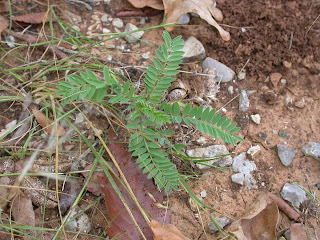
 While we didn't find leafy prairie clover, we did see Gattinger's prairie clover (Dalea gattingeri) (but it wasn't flowering). While this species is not Federally or State listed, it is restricted to the limestone barrens of the southeastern US.
 Also on the limestone barrens, Theo Witsell and I came across the small skullcap (Scutellaria parvula).... not rare, but often overlooked because of its size.

After the limestone barrens, we visited a couple of cedar glades. As seen in the photo below, the cedar glades have the obvious presence of more grasses and red cedar (Juniperus virginiana). It's hard to believe, but these communities have apparently not been fire-maintained.

 One of the plants we saw in the cedar glades was narrowleaf gumweed (Grindelia lanceolata). The genus is named for the Latvian botanist David Hieronymus Grindel. This isn't an uncommon plant, but it was one I'd never seen. I'm surprised to see that it's known from Wisconsin, as it seems to have more of a southern distribution overall. It would be interesting to compare the few remaining cedar glades in Wisconsin to those in the southeastern US.

Along a roadside near a cedar glade we saw the State Threatened tansy rosinweed (Silphium pinnatifidum, or S. terebinthinaceum v. pinnatifidum). I'd only read about this gem in the past. It grows in cedar glades in scattered counties within Tennessee (and in a band from Wisconsin to Georgia).

If you've actually read this far, you're in luck. The next two species that we saw in the cedar glades are rare in Tennessee, and one of the two is endangered in the US.
Tennessee milk vetch (Astragalus tennesseensis) is listed as Special Concern in Tennessee, but it's only known from a handful of counties in the state on cedar glades and limestone barrens. Unfortunately, it flowers in the spring, so we were only able to find the remains of some fruit.

Lastly, Tennessee purple coneflower (Echinacea tennesseensis, Federally Endangered); the first species from Tennessee ever to be designated as Federally Endangered. This species is only known from three counties within one watershed in the Central Basin of Tennessee, even though plenty of appropriate habitat is present in other watersheds nearby. Where it is present, it is abundant. At the first cedar glade, we only found it in fruit.

Rain had started to fall pretty steadily by the time we arrived at the next cedar glade. I decided I would leave my camera in the bus, as I assumed we wouldn't find anything else exciting in flower. After a 1/2 mile walk, we arrived in an opening full of Tennessee purple coneflower, and several were still in flower. I took a few photos with my cell phone, but decided it was worth a jog back to the bus in the rain to get my camera. Well worth the exercise...
Subscribe to:
Posts (Atom)